

Auteur: Steve Jurvetson
Beschrijving:
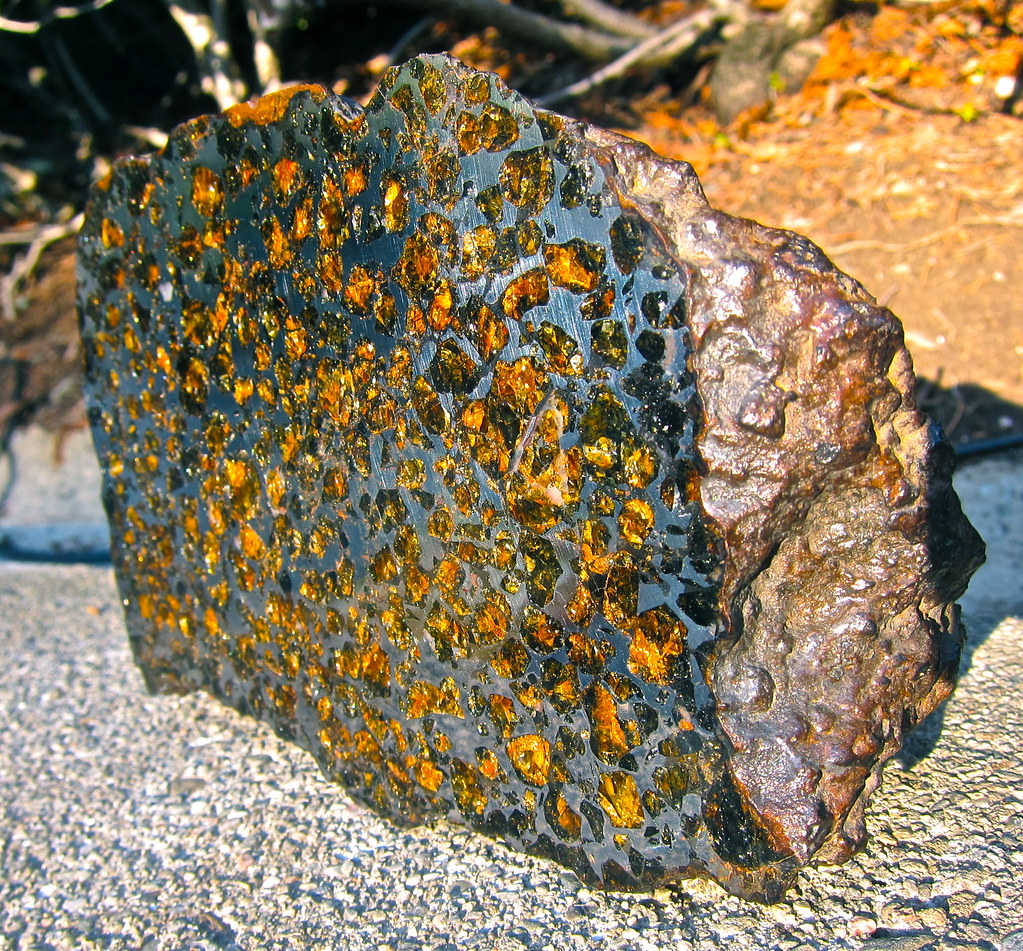
It finally arrived from the Gomel region of Belarus.
This may be the oldest thing I have held in my hands at 4.2 billion years old.
It is the result of the violent destruction of what would otherwise have been a planet during the formation of our solar system. It comes from the boundary between the silica rich mantle and the iron-nickel core of a now extinct planet, torn away by a catastrophic impact with another planet or asteroid. A mix of solid stone forming olivine crystals (37% by weight) in suspension in liquid metal (iron-nickel) was flung into space to cool over millions of years in a vacuum and zero gravity, forming this beautiful mixture (which could not be created on Earth).
This is a 3 kg end piece (cut and polished) of the Brahin meteorite fall that was first discovered in 1807 by farmers and sent to the local university scientists. During World War II, German soldiers stole samples in Kiev, and others disappeared in Minsk.
The landing site was contaminated in 1986 by the Chernobyl disaster and falls now in the Periodic Control Zone. Coordinates: 52°30'N, 30°20'E
Back to the early days, here is a timeline of billions of years ago (bya):
4.6 bya Birth of our Sun
4.5 bya Planets agglomerate from the gas disk
4.4 bya The first crust forms on a very hot Earth. It probably looked like the ocean crust, and took another billion years to stabilize into continental crust.
4.2 bya Gases from volcanos formed the Earth's early atmosphere and vapor condensed into oceans.
4.2 bya This proto-planet exploded and soon afterward,
4.1 bya the lunar cataclysm of meteorite bombardment began on the Moon and Earth.
There has been quite a bit of academic analysis of this meterorite:
• Uranium and Plutonium isotope analysis and fission track aging (like carbon dating) establishes the date of its last violent event and expulsion as 4.26 – 4.20 billion years ago: Solar System Research, 2001.
• Transmission Electron Microscopy (which I have some experience with) shows that it cooled very slowly (5 degrees per million years) and the pallasite originated deep from within the source planet: Physics of the Earth and Planetary Interiors, October 1997.
• But a bit of a unique mystery remains here, as it was superheated in two separate events during its formation (using Electron Backscatter Diffraction): American Geophysical Union, December 2009.
• Mantle-core composition (chemical, oxygen isotope and instrumental neutron activation analysis): Lunar and Planetary Science, March 1996.
• Or, from simple visual analysis: “Only 1% of all meteorites are pallasites - the most dazzling of all meteorites.” (I.M. Chait Gallery, 2011)
Perhaps this extinguished planet should be called Alderaan. =)
| Square | 75X75 | Bekijken | Download |
| Large Square | 150X150 | Bekijken | Download |
| Thumbnail | 100X93 | Bekijken | Download |
| Small | 240X223 | Bekijken | Download |
| Small 320 | 320X297 | Bekijken | Download |
| Small 400 | 400X372 | Bekijken | Download |
| Medium | 500X465 | Bekijken | Download |
| Medium 640 | 640X595 | Bekijken | Download |
| Medium 800 | 800X743 | Bekijken | Download |
| Large | 1024X951 | Bekijken | Download |
| Large 1600 | 1600X1487 | Bekijken | Download |
| Large 2048 | 2048X1903 | Bekijken | Download |
| Original | 2061X1915 | Bekijken | Download |
